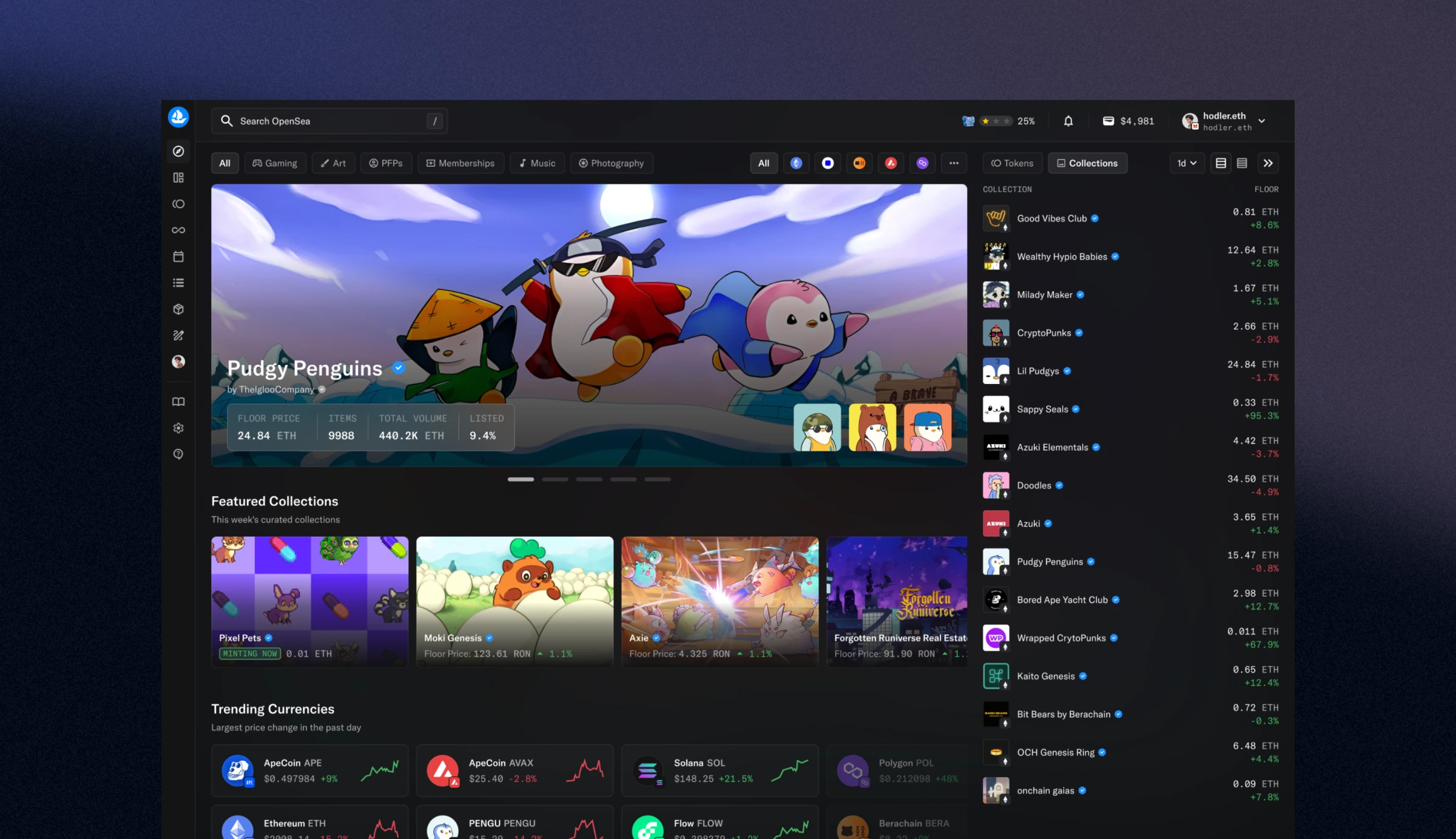
Rebuilding OpenSea Zero-to-one
I spent four years at OpenSea, and most of the last two went into one thing: rebuilding the product from the ground up. Internally we called it OS2: one product, two densities, and the system underneath.
This is the craft half of that story. The other half, about why the work was hard and what I would argue for now, is in Leaving OpenSea.
- Role
- Design Lead, web and native mobile
- Team
- Two designers, working directly with the CTO and the founder
- Timeline
- Started Nov 2023 · launched Feb 2025 · out of beta May 2025 · then native mobile
- Platforms
- Web · iOS · Android
- I owned
- Collection, Profile, Wallet, Notifications, the Tokens page (stats v1 and a full redesign), design system v1, and the NFT flows on mobile
Design was basically the product team. A lot of the job was giving direction early and then editing what an engineer had built on their own.
Where it started
OpenSea in 2021: light, airy, built for browsing.
I joined OpenSea through the Gem acquisition. Gem was an NFT aggregator: one cart across every marketplace, bought in one transaction.
My first project at Gem was batch listing, so you could sell many NFTs, from any collection, in one go. Until then, selling was one NFT at a time, with every wallet prompt, over and over.
After that I designed and shipped OpenSea Pro on my own, and it took around 60% of the pro-trader market at launch.
Then Blur launched for pro traders, with dense tables and floor sweeps built only for traders, and it pushed us toward OS2. By then there were two products, OpenSea Pro and the original OpenSea, and OS2 was the effort to bring them together: one codebase, one visual language, for very different kinds of users.
The problem
Leadership wanted one product for three very different users: normies, semi pros, and pro traders. A lot of people saw NFTs the way they'd see Pokémon trading cards, so for them the picture was the point. Pro traders bought in bulk, usually straight from the floor, and wanted dense data, not art.
My position was that we shouldn't design for normies at all. Normal people weren't buying NFTs, and the people actually using the product were collectors and traders (I'll own my bias, I came from the pro side). The compromise was a mode switch: the page morphs from airy grids into compact tables, and nothing else moves.
Homepage
Collectors browse what's featured. Traders scan the market.
Collection
Buy the way traders think: many at once. Multi-select, floor sweeping, and a cart that survives moving between collections.
Profile
We said it a lot internally: we wanted to be the Etherscan of wallets. The old profile showed off NFTs, and this one manages a whole wallet, with NFTs and tokens side by side and a portfolio treemap sized by value.
Tokens
The market moved to tokens while we built, so we caught up. Token trading went live across 19 chains when OS2 came out of beta. The swap panel is the heart of it: what you pay stacked over what you receive with a flip between them, a token picker on each side, auto slippage, and the chart right beside it. Later I redesigned the token page to bring it back into the system.
Mobile
The desktop cart, in one thumb. I designed the NFT flows for the iOS and Android apps and implemented some of them myself: browsing, multi-select, and a swipe to purchase checkout. It shipped in July 2026 with trading across 27 chains and an account that takes just an email address, with no seed phrase.
The design system
Four surfaces, two densities each, and two designers, so the system had to do the repetitive thinking. We rebuilt it from the ground up under both web and mobile, and everyone built on it. The other designer and I managed it, one engineer owned new components, and I'd go into the code and fix things myself when they drifted.
Outcome
OpenSea 2.0 was a welcomed update and drove high trading volume.
- $2.6B traded in one month (Oct 2025), 90%+ from token trading
- Token trading went from 19 chains at launch to 27 by July 2026
- Ethereum NFT market share went from 25% to 72% around the OS2 beta
What I would do differently
If I could go back I would argue the prompt should have been "Build a trading platform where anyone can trade without being on the page".
The pros were building bots to run their trades, so we were designing screens for traders who were already leaving the screen. The better question was how much of the page you should even need: how do we help anyone automate a trade, and how do we make that feel safe? Today that's a proper MCP, so your own agent does the trading instead of a page.