Building CarmenOS and learning to work with agents
I've dabbled using AI in my design workflows mostly by using Devin AI and hammering out small polish tickets at work. I want to get closer to building production grade work but admittedly I've been pretty scared of Github.
and I'm now starting to use Cursor with Opus 4.5 as my driver. Devin AI is good at investigating & researching in the code base but every visual polish item I've tried doing creates an endless back and forth where visually stuff is 98% ok but the last 2% makes me want to throw my laptop into Lake Merritt. So the only way to get closer to code in a approachable way is to use Cursor. I'm using an IDE because for the life of me I can't understand how to user Terminal. There's something bout it that inherently feels scary and it's hard to do text edits.
Ryo Lu is the Head of Design at Cursor and he has a personal site that's modeled after MacOS of mid 2000s. I took that as inspiration for building my own personal site and I'll model mine on the early Lisa OS system from the 80s.
My goal for this project was twofold:
1. Get more comfortable with the end to end process of shipping a project from scratch with AI.
2. Learn how to prompt more effectively for visual tweaks (without losing my patience)
Tooling set up
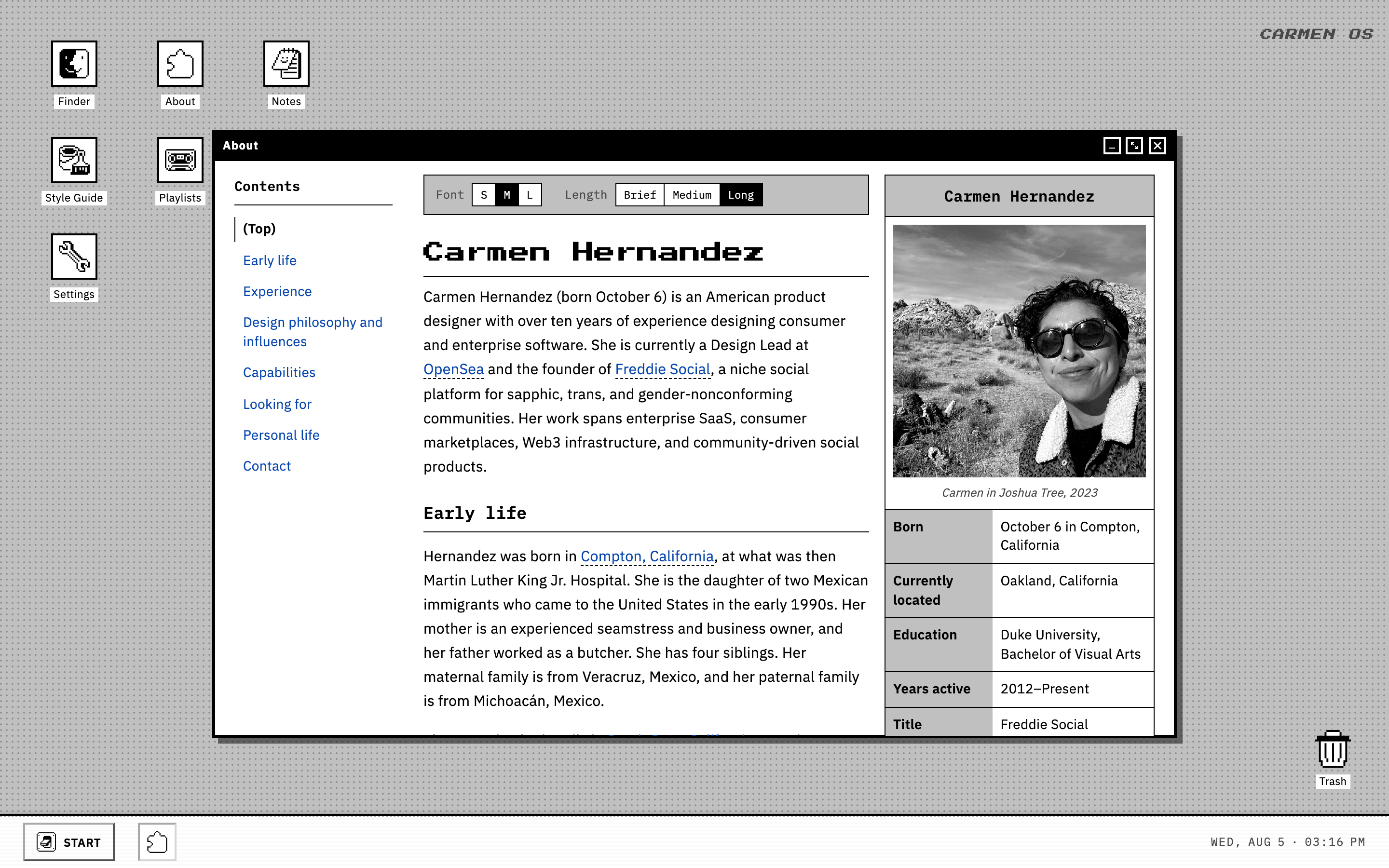
CarmenOS is a desktop operating system that lives in a browser tab. Windows you can drag, a Finder, a trash can, apps, a boot splash. It is my portfolio, except you have to open it.
I started it on 18 November 2025. It was one of the first things I built with coding agents, and that — not the windows — is what it was actually for.
It started as a Lisa
The original build was a recreation of the Lisa Office System, Apple's 1983 desktop — monochrome, boxy, deeply unfashionable. It drifted toward its own thing over time and became CarmenOS.
A music player for my monthly playlists
It filled up the way an actual desktop does. Finder, Projects, Notes, About, a style guide, a trash can that you can empty, a customise panel, a Vibe Lab.
And Spotify — which quietly became the largest single thing in the project. Roughly a fifth of every commit touches it: OAuth, a callback route, market-by-market testing, playlists, and a cassette player.
What's in the bio?
The shape of the work is visible in the history: 42 commits in November, 141 in December, then it tapers into the new year.
That December number is the thing I'd point at. That is not a pace I've ever hit on a side project before, and it's the whole reason the project mattered — not because the output was good, but because it was the month I stopped fighting the tools.
So, how did I like Cursor?
The stated goal was a portfolio. The real goal was getting comfortable building with agents, and doing that on something where nobody would get hurt if I got it wrong.
Most of what I learned wasn't about prompting. It was about process — and I learned it the way you'd expect, by losing work.
The repo still carries the scar tissue. There's a docs/agents.md with a multi-branch protocol in it, and its first rule is that an agent must check what branch it's on before doing anything, and stop and ask if the answer is main. There's a session-start checklist: check the branch, check for a clean tree, check how far behind you are, and if you're behind, stop.
None of that is clever. All of it exists because something went wrong once.
Issues with my setup
The thing I didn't expect: those protocols became how I work everywhere.
The branch check, the stash-before-anything-destructive habit, the worktree-per-agent rule, never deleting code without asking — all of that started as notes in this repo, and it's now in the instructions every agent I work with reads before it touches anything.
CarmenOS was the sandbox where I found out which rules I actually needed. The portfolio was almost a by-product.